Thursday, 25 September 2014

Theory is Spot On!


One of the things I find less fascinating about my PhD research is the absolute necessity of reading theory. When all I want is to sit down and engage with imaginary people in more or less imaginary settings, the rigorous application that theory demands from me seems more like a chore than a pleasure. One gets used to it, of course. And the next step is to realise that theory is important, not only for its academic uses, but for its relevance to reality, to real life. 
Here is an example. Walter Benjamin wrote this in One-Way Street (See One-Way Street and Other Writings, tr. by Edmund Jephcott and Kingsley Shorter. London & New York: Verso, 2006 [1979], p. 56) in the 1920s:


Even the title is portentous.
"Poverty disgraces no man." Well and good. But they disgrace the poor man. They do it, and then console him with this little adage. It is one of those that may once have held good but have long since degenerated. ... When there was work that fed a man, there was also poverty that did not disgrace him, if it arose from deformity or other misfortune. But this deprivation into which million are born and hundred of thousands are dragged by impoverishment, does indeed disgrace. Filth and misery grow up around them like walls, the work of invisible hands. And just as a man can endure much in isolation, but feels justifiable shame when his wife sees him bear it or suffers it herself, so he may tolerate much as long as he is alone, and everything as long as he conceals it. But no one may ever make peace with poverty when it falls like a gigantic shadow upon his countrymen and his house. Then he must be alert to every humiliation done to him and so discipline himself that his suffering becomes no longer the downhill road to grief, but the rising path of revolt. But of this there is no hope so long as each blackest, most terrible stroke of fate, daily and even hourly discussed by the press, set forth in all its illusory causes and effects, helps no one uncover the dark powers that hold his life in thrall."
Except for the reference to 'man' as the default position of the human race and woman ('his wife') as its complement - which is not unexpected in a text written almost ninety years ago - this text could have been written just a few days ago. 
It evokes the atmosphere of bleak disappointment that fell like a heavy blanket over Scotland the day after slightly more than half of the voters gave in to fear and said No. 
It describes the BBC's ('the press') nasty role in obscuring the truth and in propagating illusions that help to hold our lives in thrall to a corrupt system. 
It points out the only way out of this: 'not the downhill road to grief, but the rising path of revolt.' 
This path of revolt doesn't need to be, and won't be, violent, but informed, broad-minded, and determined: things, on the whole, much more scary to 'the dark powers' than violence, which 'they' know and condone and nurture, as the events at George Square showed very clearly only a few hours after their 'victory.'  
Benjamin's warning about the catalytic role of the media is especially pertinent; that is where the difference must be made, for real change. Well, it seems that things might be going towards that direction.


Wednesday, 17 September 2014

Hope or Fear?

Bus-stop on Byres Road yesterday. 
Only one day to go and the people of Scotland will decide on one of this most important of all political issues: self-determination. This referendum is not at all about ethnic identity. If it was, I wouldn't have a say in it, not being a Scot by birth. Actually, the fact that only residents are allowed to vote, regardless of their ethnic origin, while Scots who do not live here are not has caused much opprobrium, mostly to anti-independence supporters, who will accuse the pro-Indy side as 'nats' in the same breath, and never see the irony!
There is nothing nationalistic about independence: it is about self- determination, de-centering, moving away from an anachronistic, unfair political system, away from a  Union which still nurses illusions of imperial grandeur and indulges in bouts of war-mongering, towards a fairer, more egalitarian, nuclear-free society.
Bairns, Not Bombs. Independence will mean a
nuclear-free Scotland. 

 I can see why people would vote No: long habit (300 years is a not a negligible time), emotional attachment, and fear of the unknown - fear that has systematically been played upon, exploited and cultivated by the establishment en masse: UK government, media, banks, big business, even celebrities fell over themselves to convince 'the Scots' (I'd give anything to dive into their heads and see the mental image they had of 'the Scots') that they love them and please, please don't go. On the other hand, diametrically opposite this over-sentimentalised, almost saccharine attitude, the leader of the No campaign looks and sounds like the accounts manager of Grunnings [1], banging on non-stop about money, pensions and currency, and looking disgusted and sarcastic when hope, imagination, or radical ideas about self-government are brought into the discussion.
At the PostGraduate induction party today at uni, in which I was one of the hosts, the buzz was certainly pro-independence. There is no choice for me, really, but I understand that for some people it is a very hard one, and I respect that. 
But 97% of the eligible population has registered to vote. Regardless of the result, Scotland will never be the same again: people take this thing seriously, and rightly so. Even if they decide to say No to Independence - saying yes to fear and being bullied at the hands of a ruthless establishment at the same time - things will never be the same again. Within the next few years - and particularly if there is a Conservative / UKIP government in the next elections, which seems highly likely - this discussion will be revived. And there will be a resounding Yes then. But I'll be voting Yes this time round too. 


[1] Grunnings: fictional company selling drills in which Harry Potter's awful Uncle Vernon is director. I still can't understand how J.K. Rowling found it in her heart to side with those people. But I suppose they are her friends now. Oh well. Sigh. 


Monday, 8 September 2014

Reading List


Perfect pairs (but Kindle not in the picture).
Currently reading:
  • Blood of the Martyrs, by Naomi Mitchison.
  • The Merchants of Nations, by Alexandros Papadiamantis (on Kindle).
  • Western Travellers to Constantinople: The West and Byzantium, 962-1204: Cultural and Political Relations, by Krijne N. Ciggaar.
  • The First Crusade: A New History, by Thomas Asbridge.
  • The Alexiad, by Anna Komnene (Comnena).
  • Walter Scott's Journal.
  • Infancy and History: On the Destruction of Experience, by Giorgio Agamben.
  • One-Way Street and Other Writings, by Walter Benjamin.

There's a perfect symmetry in this list, I notice: four pairs of books, one of historical novels, one of historical research, one of memoirs (though The Alexiad could fit the previous category as well, it is a memoir too, IMO), and one of theory. One of them is left in my locker in the PG common study space; one is on Kindle (the Greek book, strangely enough). Only three out of the eight are library loans.

So much for statistics. I am enjoying them all, if one might be bold enough to use the word 'enjoy' for the venerable works of Agamben and Benjamin. They are all related to my research (no guilty stuff this week), one way or another. Perhaps the novels are the least directly relevant ones, but it must be remembered that the finished project will be a novel, too. You learn the craft from other novelists, not from theory, and not only on your own efforst. 

Naoi Mitchison's political engagement is powerful and very relevant nowadays (she wrote this novel in the thirties, but there is much in common with that era now, unfortunately), and I am interested in lives of slaves and of saints, which are part of my own novel as well. Papadiamantis' book is a re-read: it was a favourite historical romance of my childhood, but I am curious to see what I'll make of it now. So far I'm finding it fascinating: set in the thirteenth century Aegean island of Naxos and Venice, it is teeming with pirates, abductions, betrayals, quests, wicked and angelic characters, and medieval politics. As I read, I am half-forming a project in my mind of translating this novel into English. But this is one of the dangers of research: fascinating projects pop up from every new book, article, or paper one reads, enticing one away from the work at hand (as Benjamin would say). But there is only so much time, and the PhD must remain firmly on top as the (only?) priority, research-wise. Easier said than done. 

Friday, 5 September 2014

A Desk of One's Own, Bedroom Tax, and Lotteries

I'm not going to write about those precious things threatened by a possible Yes in the Scottish Referendum in two week's time, such as the Bedroom Tax, the National Lottery, and even private possessions (according to some terrified No supporters). I'm going to write about working space. 
Working space (i.e. a desk of one's own) is very important when you're doing a PhD, but setting one up is not as straightforward as it sounds. In theory, all PhD students are offered office space at the commencement of their studies. In practice - alas! - an office of one's own is a dream equivalent to winning the lottery. You actually have to win the lottery to get one. This is not a manner of speaking: it is the literal truth. After the academic year has started and office space has been allocated to those lucky ones whose scholarship terms particularly state they are entitled to office space (not all scholarships offer this - unfortunately mine doesn't), there is a waiting list for the rest, the order determined by lottery draws. Office space is allocated as it becomes available. Less than half of interested PhDs received one last year, and it is predicted that even fewer will receive one this year. The lottery list is only valid for the academic term, which means that you might have been one place away from getting a desk last year, but this year it's back to square one. No waiting lists. For some reason waiting lists are not on. I suppose it's considered as ludicrous, as, say, having waiting lists in the National Lottery: "Hey, I've been playing for fifty years, isn't it time I won something?" When the one and only criterion is luck, waiting lists just don't make sense.


The Itinerant Scholar, alias Academic Bag-lady,
opens shop every morning, carries it all back home
every night (no more book space in the locker).
Let so much be said for office space at uni, as Anna Comnena would say. But oh, for a room of one's own at home! One corner in the bedroom it is for me. I'm going slightly deaf from having the ipod permanently stuck into my ears, and pre-classical music doesn't do much to block the regular household noises anyway (I should be listening to Wagner perhaps, but then I'd go deaf much more quickly). If we had a spare room at home to turn into a study, we'd have to pay bedroom tax for it. Many would think that it's rich of the poor to want luxuries such as workspace for intellectual pursuits. The poor have no business being intellectuals, is what they think. 

 I'm not complaining, mind: I made certain choices in my life, which I don't regret for a minute, and which led to a - shall we say - definitely not opulent lifestyle. I'm happy with that. I don't ask for the taxpayer to fund my intellectual habit, either. (I do question - no, I directly refute and reject - the fairness of the Bedroom Tax, though). It would just be nice to have more support for intellectual pursuits where intellectual pursuits are institutionally nurtured. There surely must be a better way to do this than a lottery!  

 I inquired and was informed that the College of Art's decision had the support of student representatives. Fair enough, and this is what democracy is all about: representatives speak for those whom they represent. The good thing is that within such a system, as long as you speak to your representatives, and your representatives speak for you, you can change things that seemed a good idea at the time but don't really work after all. (Something for voters to think about for Sept. 18)

In the meantime, it' is a Corner of One's Own for me in the Postgraduate Study space for the CoA. I'm getting fond of it. Lovely soothing blue on the wall, and it's really quiet, so pre-classical music is fine even at a low volume. 


Thursday, 14 August 2014

Book in the Post

A book I ordered on the post arrived today.  Here it is:                               


What the pictures can't convey is the musty smell of the old book (which I  bought for less than three pounds, most of it for p/p) and my joy in actually holding it in my hands. You see, this book was described as "inaccessible" in another academic book. That one, on foreign visitors in Constantinople between the tenth and thirteenth century, became available to me through an interlibrary loan. I got access to both books within three or four days after requesting them, and without having to travel far and wide in order to get  them (well, I had to go to the University Library for the ILL[1] one, but that's not far. At any rate you are supposed to see the inside of a library while you're doing a PhD, even nowadays).   
There really is no "inaccessible" today, is there? 

[1] ILL: InterLibrary Loan. A wonderful thing, for which universities pay quite a bit of money, sparing you the trouble (and expense) of going on a quest to find a book necessary to your research yourself. But it seems there are people who order books and then don't bother to go pick them up. Recently the university has decided to impose a penalty - a fiver - in such cases. 


Friday, 8 August 2014

A Novel is Born

It is funny where ideas come from, and how they sort of gestate and develop and form over time. And then you have a substantial piece of work, a book, and you look at it and say to yourself: even if nobody else knows it, even if it's never going to be published, or even if it is and few people read it, I've done this. Regardless of what happens in future, I've done it. This is a feeling that no negativity can take away from me.


The novel in embryonic form: file cards.
The important thing is to capture the ideas as they come. I tend to use filing cards in the first stage of gestation (I'm sure this is a very silly metaphor, but in my mind it is associated with warm eggs protruding from the straw - a very vivid picture from my childhood, though I lived in a rural setting for only four years).  

 First I write down some questions and ideas and then look up for books that might help my research. The cards are perfect for this: easy to carry about in your purse, minimum fuss when you go into the library. In the PhD there is a lot of theoretical research as well as the factual stuff you need for a historical novel. The file cards are not only light and versatile (for hasty note-taking), but they are traces of all my various searches, reference and archive in themselves. 


Research is obviously indispensable, but there is a trap - actually more than one, but I'll deal with research particularly for historical fiction in future posts. In a creative writing project the most important thing is to keep writing the story, the novel, the poems, the play, or whatever it is one is writing. But it's very easy to spend hours and hours reading up and taking notes on research and neglecting the writing part. I suppose the same goes for any other PhD, too. Research as a form of procrastination, or perhaps an expression of fear: a wish to put off the moment one has to deal with the work itself. 
My novella The Life and Times of Milagros Riquelme was first written in these notebooks.
The early ones have very little in common with the actual
text as it was submitted for my MSc dissertation. 
My remedy for this is - what else could it be? - to write. Even if it's silliness, or incoherent phrases establishing a mood, or setting a scene, or a half-formed conversation, I fill in those notebooks, or I type and type like there's no other thing in the world. For a few hours, everyday. Even for a few minutes, if it can't be hours. (Eventually it will have to be, but that's another tune, which I'm sure I'll be singing in a years' time).

Is it a good thing to be a split personality and do and keep your writing in two different media and various devices? I'm sure more organised people than myself would decide what method is best for them - longhand? typing? - and stick to it. I am writing this post on my laptop, and some of my notes and first drafts are here, on on the ipad. But the very first formulation of an idea, a story, a character, is and always will be in longhand, on file cards and notebooks. I've come to see those as planting pots, or small patches of earth, where the first seeds are deposited. When I'm fidgety and restless in front of a blank computer screen, I shuffle the cards, or rummage through the notebooks. 
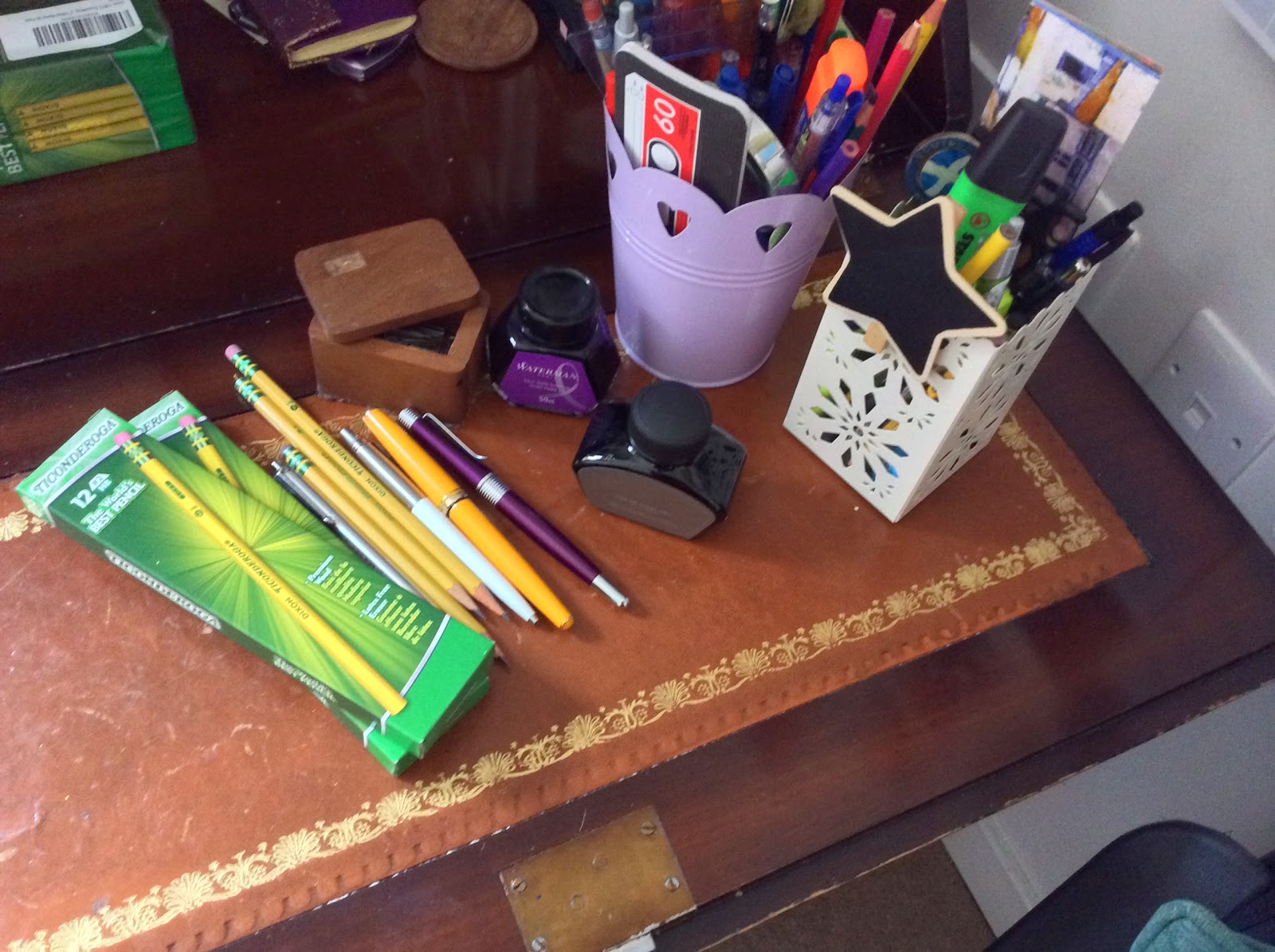
Implements for purple prose.

Pens, pencils, and fountain pens are also important for analogue me (see previous post). I love my Cross pen, and purple ink: it reminds me of my grandfather whom I never met, a teacher; he died in 1956, in his late forties. He used to write letters in purple ink, with that elegant hand which people took the time to practice back then. There is something about words written in purple ink: they seem to be more alive, to be flowing from one end of the page to the other. Blue is dull, black is funereal; there is a whiff of legal papers and of the notary in a page scrawled in black. But purple is good: kind to the eyes, vivid, and a little bit old-fashioned. Just like what I want my writing to be. 


Thursday, 7 August 2014

Analogue and Digital

I envy my son. Not (only) because he's young and intelligent and beautiful, but because he was born well within the digital age. His first pictures my family saw were sent over the Internet; he reads and plays both in the real and the virtual world; computers and technology have no secrets for him. 

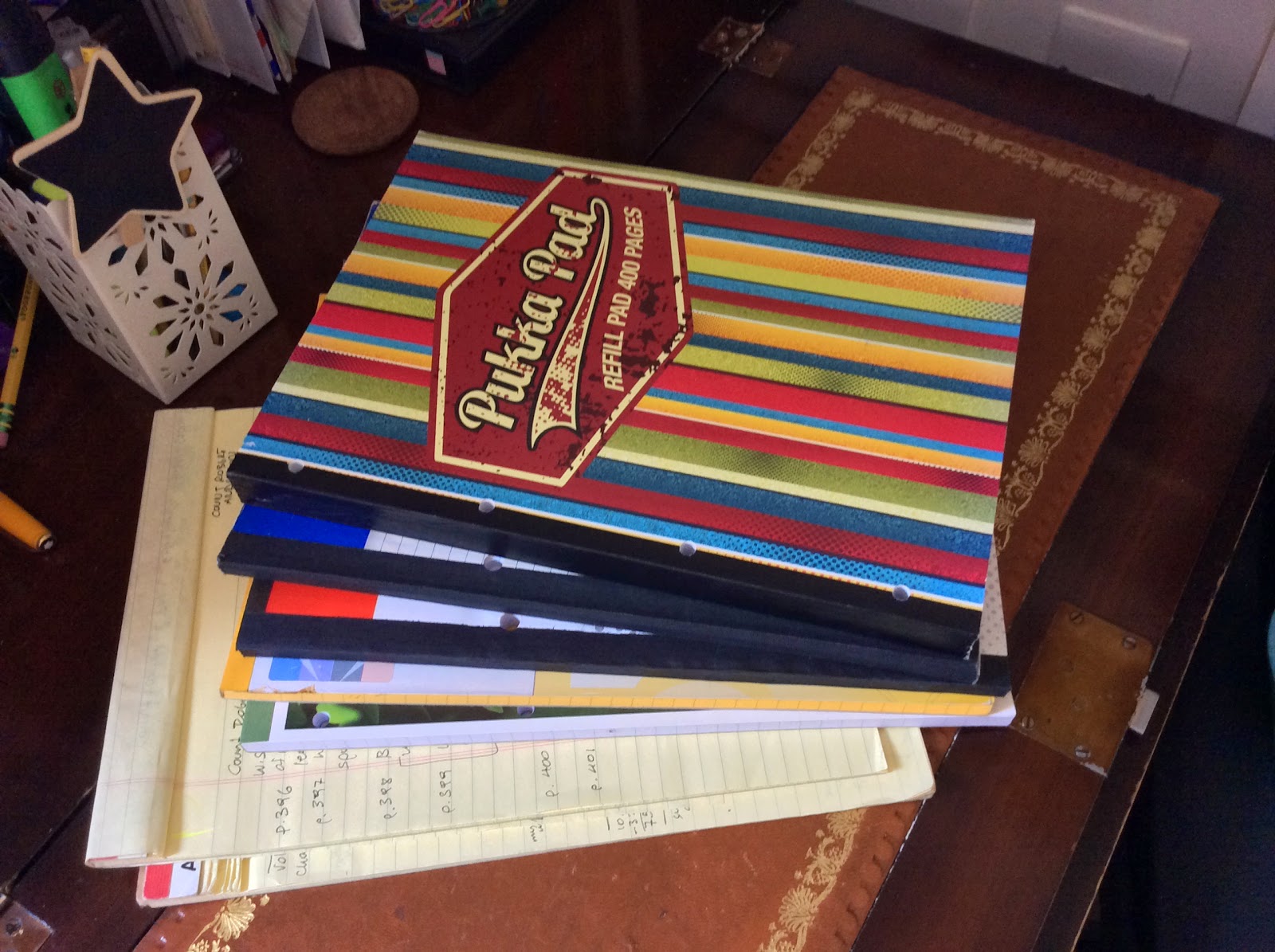
PhD Project: a notebook for each role.
I am a different story. Computers had been invented when I was born (I'm not that ancient), but I don't think private citizens owned them then - not in Greece in the late sixties, at any rate: there must have been something like six or seven room-sized ones in the possession of banks and research centres, perhaps. At school we were taught to read in books made of paper, to write with pens and pencils, to do our research in libraries where you had to use a step-ladder, and be covered in dust - and sometimes cobwebs. 
Sribophilia? Is there such a condition?
When I began to use a computer in the late eighties, as a sort of posh typewriter for writing and printing mostly, it was new and exhilarating (look! you type in and then you can overwrite and it changes on its own!), although it took me a while to get used to typing in the appropriate commands for everything. (I've mentioned the unexpected benefits of this many years later, in my very first post.) Then came the nineties and the developments were so fast - the white screen! the icons! THE INTERNET! THE LAPTOP! - that I can't keep track of them. By then, a schizoid pattern in my work had already been established. Journals, stories, the occasional (bad) poem, translations, letters, essays, dissertations, notes, in big floppy discs, in small floppy discs, then no discs but sticks. In notebooks and notepads of all shapes and sizes. Yellow rubber-tip pencils and fountain pens and rollerballs. PC, laptop, ipad. Being both a stationery fetishist and a gadget maniac, it is obvious that I am being literal when I'm saying that my work is all over the place. 
Best thing about being a student again?
New note pads!

Analogue or digital? The younger generations are blissfully unaware of the dilemma. But for me it's real. You do more with a machine, it's true. Writing is faster and the ideas flow, and not having to strain your eyes to decipher it later is an added bonus. But nothing smells as nice as a stationery cupboard full of old, worn, worked notebooks, and brand new ones waiting to be used, bright and pristine, as beautiful in their way as bridal accessories (and without the complications involved). An ipad doesn't smell of anything - neither does a laptop. You can't press a sprig of basil inside it and discover it many years later and try to remember where and when and how. Yet you can shape and reshape painlessly, and share quickly. And print. 
The Apple Orchard

Oh well. I'll be both analogue and digital all my life, I think. If it's a question of head vs heart, it's not even a choice: you need both, you can't do without one or the other. But writing - the physical act of writing - has a little to do with, you know, those greats you've been looking up to all your life: the Prousts and the Yourcenars, the Austens and the Woolfs (Woolves?): their quills and fountain pens, their sheets of paper whisked away when visitors came and their typewriters clicking away in an empty Bloomsbury house. What would they have done? What would they have chosen, given the choice? 
Who knows?
 But does it matter really?